


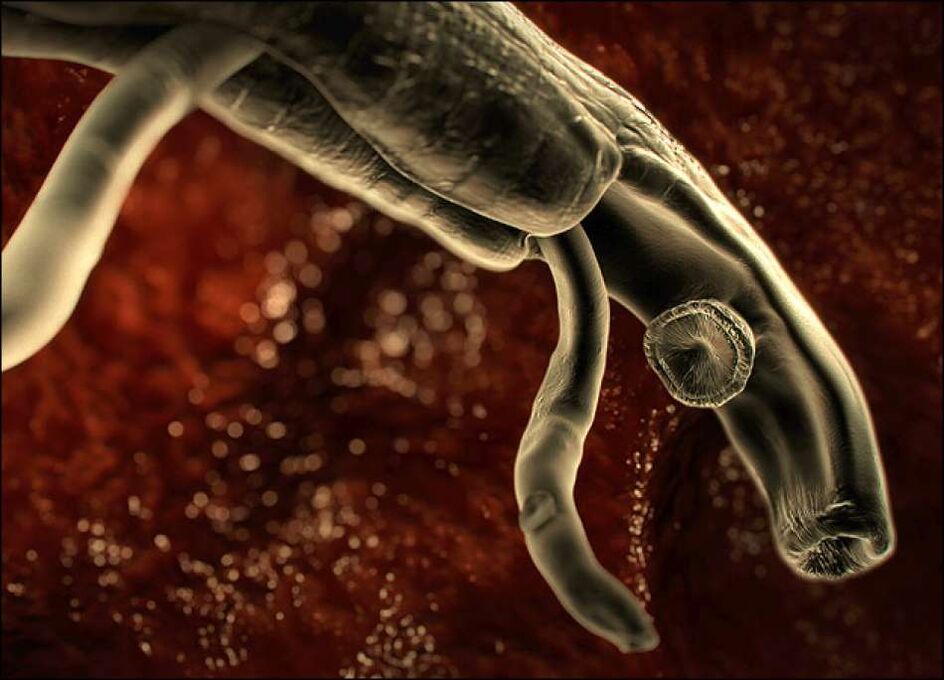
Parasites in the human body lead to the development of serious diseases.Their harmful effects significantly affect life expectancy.
According to research, almost all people are carriers of certain parasites (from the smallest, which can only be seen under a microscope, to the 10-meter tapeworm).Unfortunately, parasites do not only live in the intestines.Their habitat: the intestinal tract, muscle tissue, heart, blood and even the brain, as well as other vital human organs.
No one in the world, not a single person, is free from parasites entering their body.Moreover, the person's age (whether child or adult) and status (rich, poor, famous, unknown, etc.) do not matter.
Types of parasites
For example, there are parasites such as hookworms.During their life cycle, they certainly visit almost every organ of our body.Why is this so?Because hookworm larvae, when they enter the soil from the feces, remain viable for several weeks.And if during this time they get on the human skin, they chew through it and thus enter the blood vessels.And they are transferred to the lungs with the blood flow.Once these larvae are in the alveolar capillaries, they enter the alveoli of the lungs to ascend into the airways.They then enter the pharynx and are swallowed.At the same time, they literally chew themselves through the entire journey.To chew through our lungs, intestines and blood vessels, nature endowed them with four protruding hook-shaped teeth.Once in the intestines, the hookworm, which feeds on blood, can remain there for up to 14 years, thanks to the gnawing of the intestinal mucosa.According to research, hookworm disease affects more than 650 million people worldwide today.
Another parasite, alveococcus (a class of helminths), creates specific formations in the body - fins.It is a capsule consisting of a collection of small bubbles called alveococcal finna.In this case, the bubbles do not contain liquid.They grow into human tissue by external budding and are similar to a malignant tumor.This disease occurs as a malignant formation. Alveococcosis is rare, but mainly affects the liver and brain.The diameter of alveococcal nodes reaches 15 cm.This type of helminthiasis is difficult to diagnose.Therefore, in most cases, the diagnosis is made at a late stage, when surgical intervention is no longer possible.
All parasites are merciless and ungrateful.To stay in the "master's house" as long as possible, they use sharp hooks, clothespins, plates - teeth made of chitin (its density resembles nails) or hard wire hairs (whipworm).These unique devices constantly damage the mucous membrane of the gastrointestinal tract, burden the liver with waste, take away food from the person, which reduces immunity and inhibits beneficial microorganisms.The vital activity of bacteria synthesizing B vitamins, as well as lactic acid bacteria and interferon donor bacteria is inhibited.And all this is intestinal immunity, that is, almost half of the human immune mechanisms.
Thanks to our unique camouflage, we can be unnoticed by two or more types of parasites at the same time.In the liver - lamblia, in the intestines - roundworms.In fact, a large number of patients suffering from anemia, chronic fatigue, pancreatitis, asthma, allergies, dysbacteriosis, gall bladder and others are infected with parasites.
If we talk about the symptoms of parasite infection, they may not appear at all.Despite the invasion, a person can feel completely healthy if he has good immunity.It will really be healthy for some time strictly individually.After that, as the immune system fades (due to stress, illness, surgery), the parasite continues to send weak signals.They are characterized by pimples on the skin, foul-smelling urine, persistent cough with clear lungs, loose stools with a strong odor or constipation, gas and bad breath.Nighttime teeth grinding (bruxism) is considered the most obvious manifestation.Symptoms may include drooling, poor appetite (nocturnal or insatiable hunger), food cravings (sour and sweet foods), and belching air.Sometimes you will meet people with increased appetite while losing weight.Unfortunately, the number of possible symptoms is almost endless.Parasites are so "cunning" that they mask their presence with the symptoms of the most common diseases.
Parasites acquired from pets
Pets can give us not only their love and affection, but also other, much less pleasant "gifts".In order for doctors not to learn practical parasitology about our bodies, we need to know exactly what threatens us and how to treat it.
Ascariasis
Who broadcasts it?Pig, cat, dog, human.With excrement, the pathogen enters the soil, and from there it reaches humans through unwashed hands and vegetables.Transmission of ascariasis through strawberries, which are tasted unwashed in the market, is also common.Ascaris lives in the small intestine of a person for up to 2 years, eats useful substances and poisons it with the products of its vital activity.Ascaris eggs live in the soil for up to 10 years.
Symptoms: weakness, allergies, rashes, poor appetite, weight loss, nervousness, poor sleep.With a healthy lifestyle, there may be no symptoms.If the worms have multiplied and entered the respiratory tract, coughing is possible.
What to do: Pumpkin seeds are useful as a prevention against roundworms - a handful a day.If you suspect ascariasis, do a stool test at the clinic.This disease is treated with antiparasitic pills.
Giardiasis
Who broadcasts it?The natural carrier of Giardia is the cat.It could also be contaminated soil or well water.It can spread from person to person with contaminated hands.It often occurs in children.
Symptoms: Giardia settles in the duodenum, clogs the ducts of the gallbladder and pancreas (visible on ultrasound), these organs disturb the patient, food is poorly digested and absorbed, poor appetite.
What to do: take the stool to the clinic.If the diagnosis is confirmed, the doctor prescribes pills.Do not try to get rid of Giardia with "vormil" - it has no effect on them.The cat must also be treated: buy Drontal or Droncid at the veterinary pharmacy, give according to weight, according to the instructions, once every 3 months.
Toxocariasis
Who mediates: dog, sometimes cat.This is a canine roundworm that does not take root in the human intestines, but penetrates the blood, feeds on its proteins and releases toxins there.It often affects children.
Symptoms: same as other parasites, but nothing found in stool;the blood should be tested.Sometimes toxocara enters the eyes through the bloodstream and can cause blindness.The ophthalmologist can see the pathogen in the fundus.
What to do: if you have suspicions, go to the clinic for an examination.Toxocariasis is easy to cure, but difficult to find and suspect.
Toxoplasmosis
Who broadcasts: cat.The pathogen lives in the blood.
Symptoms: sometimes - mild fever, weakness, liver enlargement, fatigue, muscle pain, headache.Often there are no symptoms, only the weakest organ suffers.You won't suspect anything from the cat's behavior either, but you can take the cat's excrement to a veterinary hospital for analysis.
What to do: go to the clinic.
Dirofilariasis
Spread by: dogs, mosquitoes.After biting a sick dog, the mosquito bites a person and transmits the pathogen.The larva grows, travels throughout the body and stops under the skin or in the eye.There was a case when a 23-centimeter heartworm was pulled out of a woman's eye.A maximum of 3 heartworms can live in one person at a time.
Symptoms: migrating subcutaneous tumor, feeling of movement in it.
What to do: Go to an infectious disease clinic or surgeon to have it removed.Watch the dog: if it walks weakly, drowsily or drags its legs, this is already suspicious.60-80% of stray dogs have heartworm larvae.Treatment of such sick animals is usually not carried out, since two out of three dogs die from toxic drugs, and the survivor does not fully recover.Prevention method: window nets and mosquito repellents.
Against roundworms and giardia, take a small head of garlic or 2 large cloves, chop it up, pour half a liter of hot milk into a thermos overnight.You can drink half a glass three times a day in the morning before meals for 10 days.The recipe is suitable for pregnant women for whom antiparasitic tablets are contraindicated.Garlic has no effect on dog roundworms because they live in the blood and not in the digestive system.
Self defense
- Wash your hands with soap twice before eating.
- Wash the vegetables and strawberries under cold running water, peel them, put them in a colander in 1-2 layers, pour boiling water over them and rinse them immediately with cold water, so that the vitamin C is not destroyed.
- Treat pets regularly for parasites.Wash your hands afterwards.
- If you have a pet at home, check yourself sometimes for parasites and check your children, especially if they have recently been weak, allergic or have no appetite.
Well, if you do get sick, see a qualified doctor as soon as possible.An experienced specialist prescribes a course of treatment that will help you recover as soon as possible.